


Coal washing and raw coal conveying are core links in the coal preparation industry, responsible for removing gangue, separating clean coal, medium coal and gangue, and realizing standardized transportation of coal materials. The entire coal processing workflow involves high-speed flow of dense medium slurry, coal water mixture, granular raw coal and fine coal powder. These materials feature high hardness, strong fluid scouring force and continuous cyclic impact, resulting in extremely severe abrasive wear, impact damage and minor corrosion on the inner walls of process equipment and conveying facilities. Traditional carbon steel, alloy steel and common anti-wear rubber accessories have long been unable to adapt to long-term high-load working conditions of coal preparation plants.In actual coal plant operation, key equipment such as cyclone separation systems, conveying pipelines, transfer hoppers and storage silos suffer rapid wall thinning, local perforation and frequent material leakage. Most steel pipelines and hoppers need overhaul and replacement within 6 to 12 months, while cyclone equipment will lose classification accuracy due to inner wall wear, directly reducing coal washing efficiency and clean coal yield. Frequent equipment shutdown maintenance not only consumes a large amount of manpower and spare part costs but also seriously restricts the continuous and stable production capacity of coal preparation enterprises.With the upgrading of coal industry intelligent and high-efficiency production standards, wear-resistant ceramic parts have become the mainstream anti-wear renovation solution for coal washing and conveying systems. Made of high-purity alumina ceramic with super high hardness and excellent anti-scouring performance, these professional ceramic lining components can effectively resist long-term impact and abrasion of coal slurry and coal particles. Verified by a large number of coal plant practical projects, ceramic lining can extend the service life of coal processing equipment by 8 to 15 times compared with traditional metal materials, greatly reducing maintenance frequency and comprehensive operating costs. This article comprehensively elaborates on the full-scene application value of wear-resistant ceramic lining in coal washing systems and coal material conveying systems, providing professional technical reference for coal plant equipment anti-wear upgrading.
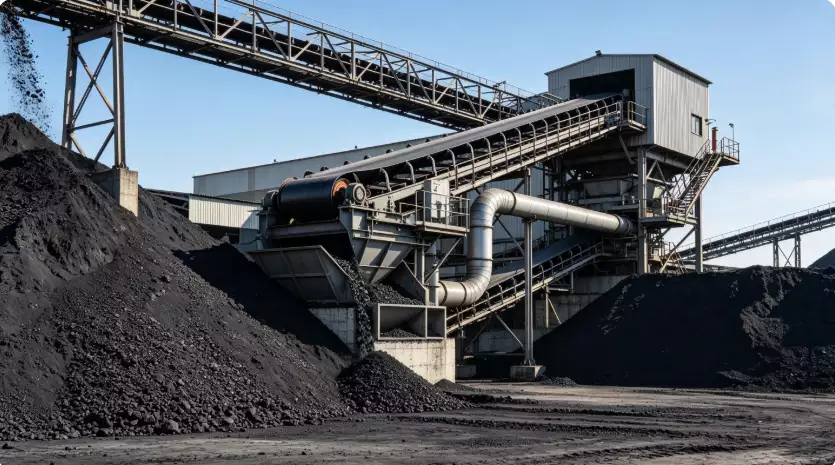
Different from metallurgy, power and mining industries, coal processing working conditions have unique characteristics: mixed wear modes of slurry fluid scouring and solid particle impact, low-temperature weak alkaline coal water medium, and continuous 24-hour cyclic operation. Ordinary anti-wear materials are prone to aging, deformation and failure in coal washing environments, while professional coal-industry-specific wear-resistant ceramic lining has targeted performance advantages to adapt to complex coal plant working conditions.First, ultra-high abrasion resistance. High-purity alumina ceramic raw material reaches Mohs hardness 9, far higher than steel and rubber materials. It can resist continuous high-speed scouring of dense medium slurry and fine coal particles, and will not produce wall thinning and surface damage after long-term operation. Second, stable chemical inertness. Ceramic materials do not react with coal water, dense medium suspension and other coal washing media, avoiding corrosion and aging failure, ensuring stable equipment performance for a long time. Third, smooth and dense surface. The seamless ceramic inner wall effectively prevents fine coal adhesion and material blockage, avoiding coal accumulation and pipeline clogging problems that plague traditional coal washing equipment.Fourth, excellent impact resistance and structural stability. Through optimized mosaic pasting, bolt fixing and composite vulcanization processes, ceramic lining can bear continuous particle impact without peeling and falling off. Fifth, easy installation and flexible customization. According to different coal plant equipment structures such as curved cyclones, straight pipelines, special-shaped hoppers and drum surfaces, custom wear-resistant ceramic parts can be processed and formed to meet the anti-wear needs of all links in coal washing and conveying systems.
The coal washing system is the core process of coal preparation plants, mainly relying on cyclone separation equipment to realize density classification and impurity removal of raw coal. Dense medium cyclone equipment operates in high-speed slurry circulation state all year round, and the inner wall bears the strongest scouring and abrasion in the entire coal plant. Wear-resistant ceramic lining is widely applied to pressure cyclones, non-pressure three-product dense medium cyclones, non-pressure four-product dense medium cyclones and concentrated cyclone groups, solving the problems of fast wear, low classification precision and short service life of traditional cyclone equipment.
Pressure cyclones are widely used in coarse coal and lump coal washing processes. The equipment relies on pressure difference to drive dense medium slurry and raw coal mixture to rotate at high speed, realizing gravity separation of clean coal, medium coal and gangue. The inner wall of the cyclone inlet section, cylinder body, cone section and overflow pipe is continuously scoured by high-pressure high-speed coal slurry. Traditional cast iron and polyurethane lined cyclones wear rapidly under long-term pressure scouring. The inner wall wear will change the internal flow field and structural size of the cyclone, resulting in reduced separation accuracy, mixed gangue in clean coal and reduced coal washing yield.After lining with high-purity wear-resistant ceramic tiles, the inner wall of the pressure cyclone maintains a smooth and complete structural state for a long time. The super-hard ceramic surface resists slurry scouring and particle impact, avoiding structural deformation caused by equipment wear. Practical application shows that ceramic-lined pressure cyclones have stable separation efficiency for a long time, effectively improving the qualified rate of clean coal products and reducing medium loss in coal washing processes.
Non-pressure three-product dense medium cyclone is mainstream core equipment in modern large-scale coal washing plants, which can simultaneously separate clean coal, medium coal and gangue in one operation, with high processing efficiency and wide application range. This type of cyclone operates under non-pressure gravity flow conditions, and the cone section and underflow discharge port are the most vulnerable parts, which are impacted and scoured by high-concentration coal medium mixture for a long time.Traditional metal three-product cyclones need regular maintenance and wall repair every 8 to 10 months, and frequent shutdowns affect continuous coal washing production. Installing wear-resistant ceramic lining on the inner wall of the cyclone cylinder, cone and discharge section can greatly improve the overall anti-wear performance. The integrated ceramic lining structure has no gaps and dead corners, ensuring uniform slurry flow and stable classification effect. It completely solves the problems of local wear, material accumulation and separation efficiency attenuation of three-product cyclones, and extends the equipment service life by more than 10 times.
Non-pressure four-product dense medium cyclone is an upgraded coal washing equipment, which can realize four-way separation of ultra-clean coal, clean coal, medium coal and gangue, and is suitable for high-precision coal sorting scenarios. Due to the complex internal flow channel structure and multi-branch discharge design, the flow direction of coal slurry changes frequently, and the local scouring force of the inner wall is stronger, leading to more serious wear problems than three-product cyclones.Targeted customized special-shaped wear-resistant ceramic parts are adopted for four-product cyclones, carrying out full-coverage lining protection for inlet flow channels, rotating cylinders, multi-group cone sections and discharge branches. The customized ceramic lining perfectly fits the complex curved structure of the four-product cyclone, ensuring no dead-angle wear in the flow channel. While improving equipment wear resistance, it maintains the precision of multi-product separation, helps coal plants realize refined coal classification, and improves the economic value of coal products.
Concentrated cyclone groups are key equipment for coal slurry concentration, fine coal recovery and coal water purification in coal washing plants. Multiple cyclones operate in parallel to realize centralized treatment of coal slurry, with large slurry processing capacity and long continuous operation time. The inner wall of each cyclone unit and the connecting branch pipes are worn by fine coal particles for a long time, which easily causes pipeline thinning, slurry leakage and reduced concentration efficiency.The overall anti-wear renovation of concentrated cyclone groups with wear-resistant ceramic lining can realize synchronous protection of single cyclone equipment and connecting pipelines. The excellent anti-scouring performance of ceramic materials ensures the stable operation of the cyclone group system for a long time, reduces the failure rate of fine coal recovery and coal slurry concentration, and improves the resource utilization rate of coal washing waste water and fine coal powder. For coal plant cyclone group system renovation projects, complete sets of anti-wear solutions are available at professional ceramic wear-resistant parts for coal washing cyclones.
The coal conveying system undertakes the transportation, transfer and distribution of raw coal, clean coal, medium coal and gangue in coal plants, including pipeline conveying, gravity transfer and belt conveying links. Raw coal and coal powder have high hardness and strong fluidity, causing serious abrasion and impact damage to conveying equipment. Wear-resistant ceramic lining and ceramic composite anti-wear products are widely used in conveying pipelines, elbows, hoppers, silos, distribution ports and ceramic drum rubber coating, solving various wear pain points in coal conveying links.
Coal conveying pipelines and elbows are the most severely worn equipment in the coal conveying system. Straight pipelines bear long-term sliding abrasion of coal particles and coal slurry, while elbows bear concentrated impact and centrifugal scouring when material flow changes direction. Traditional steel pipelines and elbows are prone to perforation and leakage within half a year, causing material waste and site dust pollution, and requiring frequent shutdown replacement.Ceramic-lined steel pipes and ceramic wear-resistant elbows adopt composite structure of steel outer pipe and integral ceramic inner lining. The high-strength steel layer ensures structural stability and pressure resistance, and the ceramic inner layer provides ultra-strong anti-wear and anti-scouring performance. It can adapt to long-term high-speed conveying of raw coal, fine coal and coal slurry. After renovation, the service life of coal conveying pipelines is increased by more than 10 times, which effectively avoids pipeline leakage failures and ensures stable material conveying efficiency.
Coal hoppers and coal silos are important buffer and storage equipment in coal plants, responsible for temporary storage and uniform feeding of raw coal and finished coal products. The cone transition section and discharge port of hoppers and silos bear long-term static pressure friction of stacked coal materials and dynamic impact of falling materials. The inner wall of traditional steel silos is easy to wear and rust, and wet coal materials are prone to adhesion and blockage, affecting continuous feeding.Pasting mosaic wear-resistant ceramic tiles on the inner walls of hoppers and silos can effectively resist particle abrasion and material impact. The smooth ceramic surface avoids wet coal adhesion and coal bridging blockage, reduces manual cleaning frequency, and stabilizes feeding uniformity. It solves the problems of uneven feeding and production interruption caused by silo wear and material accumulation, and improves the overall operation efficiency of the coal conveying system.
Coal material distribution ports are used for shunting and distributing coal materials to different production links. The frequent switching of material flow direction leads to concentrated scouring and impact on the inner wall of the distribution port, resulting in rapid local wear and structural damage. Wear deformation of the distribution port will cause uneven material distribution and affect the balanced operation of subsequent coal washing and conveying equipment.Custom-shaped wear-resistant ceramic blocks are used for full coverage protection of distribution port inner walls and shunt baffles. The high-hardness ceramic material resists repeated material scouring and impact, maintains the complete structural size of the distribution port for a long time, ensures accurate and uniform material distribution, and avoids production fluctuations caused by uneven material shunting.
Belt conveyor drums are core power transmission components of coal conveying systems. Coal dust and fine coal particles are easy to accumulate between the drum and the conveyor belt, causing abrasive wear on the drum surface and belt slippage and deviation. Slippage will reduce conveying efficiency, accelerate belt aging and damage, and even cause safety accidents such as belt burnout in severe cases.Ceramic drum rubber coating is a special composite anti-wear and anti-slip product for coal industry conveyor drums. It is composed of elastic rubber substrate and embedded high-hardness ceramic particles. The exposed ceramic particles greatly improve the friction coefficient between the drum and the belt, completely eliminate belt slippage and deviation, and ensure stable conveying capacity. At the same time, ceramic particles resist the abrasion of coal dust particles on the drum surface, protect the metal drum matrix, and extend the service life of drums and conveyor belts. This cost-effective anti-wear solution has become a standard upgrading project for coal plant belt conveying systems, and high-quality products can be obtained fromcoal industry dedicated ceramic wear-resistant parts.
The application of wear-resistant ceramic lining in coal washing and conveying systems brings multi-dimensional value improvement for coal preparation enterprises, covering equipment stability, production efficiency, maintenance cost and product quality. First, it greatly extends equipment service life. Ceramic lining solves the problem of rapid wear of cyclones, pipelines, hoppers and drum equipment, reduces the replacement cycle of vulnerable parts, and avoids frequent production shutdowns caused by equipment failure.Second, stabilize coal washing quality and yield. Ceramic-lined cyclone equipment maintains accurate internal structural size and stable flow field, ensuring consistent coal separation accuracy, improving clean coal yield and product qualification rate, and creating direct economic benefits for enterprises. Third, reduce comprehensive operating costs. Although the one-time investment of ceramic anti-wear renovation is slightly higher than traditional materials, it saves a large amount of spare part procurement costs, manual maintenance costs and production loss costs caused by shutdowns in the whole life cycle, with extremely high cost performance.Fourth, improve on-site production safety and environmental protection level. Ceramic lining avoids material leakage and dust pollution caused by equipment wear, reduces on-site cleaning workload, and realizes stable and environmentally friendly production. Fifth, reduce equipment failure rate and labor pressure. The stable performance of ceramic components reduces daily inspection and maintenance frequency, saves human resources, and reduces the working pressure of equipment maintenance personnel.
With the continuous development of intelligent, green and high-efficiency production in the coal industry, coal preparation plants have put forward higher requirements for equipment operation stability, low energy consumption and low maintenance. Traditional metal and rubber anti-wear materials can no longer meet the long-cycle and high-efficiency production needs of modern coal washing and conveying systems. As a mature and reliable anti-wear technical solution, wear-resistant ceramic lining has been widely recognized and promoted in large, medium and small coal preparation plants nationwide.In the future, with the continuous upgrading of ceramic composite material technology and personalized customization technology, high-performance ceramic wear-resistant components will be further popularized in more coal industry scenarios, including underground coal mining conveying systems, coal slime processing equipment and coal gangue sorting equipment. It will continue to empower the high-quality development of the coal industry, help coal enterprises reduce costs, increase efficiency, and realize intelligent and green production upgrading.
Coal washing and material conveying systems are key production links that determine the operational efficiency and economic benefits of coal preparation plants. Equipment wear has always been a major industry pain point restricting the stable operation of coal plants. Wear-resistant ceramic lining and supporting ceramic wear-resistant parts have targeted and solved the wear problems of core equipment in coal industry scenarios. In the coal washing system, it is widely used in pressure cyclones, non-pressure three-product dense medium cyclones, non-pressure four-product dense medium cyclones and concentrated cyclone groups, stabilizing coal washing precision and improving clean coal yield. In the material conveying system, it fully covers conveying pipelines, elbows, hoppers, silos, distribution ports and ceramic drum rubber coating, realizing full-link anti-wear protection for coal transportation.Compared with traditional anti-wear materials, ceramic wear-resistant parts have outstanding advantages such as ultra-long service life, stable performance, no material blockage, low maintenance cost and high cost performance. For modern coal preparation enterprises, carrying out anti-wear upgrading of coal washing and conveying equipment with ceramic lining is not only an effective means to solve equipment wear failure, but also an important measure to stabilize production quality, improve production capacity and reduce long-term operating costs. With its superior comprehensive performance, wear-resistant ceramic parts have become the preferred anti-wear solution for high-efficiency production of modern coal washing plants.

Подайте ваш запрос,
Мы свяжемся с вами как можно скорее.

Sanxin New Materials Co., Ltd. специализируется на производстве и продаже керамических бусин и деталей, таких как шлифовальные средства, струйные бусины, подшипник, часть конструкции, керамические износостойкие вкладыши, наночастицы нанопорошка


 Английский язык
 Английский язык
 Русский язык
 Французский язык
 На испанском языке
 На португальском языке
 Арабский язык