


Thermal power generation is a core pillar of global energy supply. A complete thermal power plant includes coal receiving and stockyard systems, bulk‑coal block‑material conveying systems, pulverizing systems, pneumatic powder‑transport pipelines, boiler combustion equipment, flue‑gas treatment and ash‑slag discharge systems. Throughout the whole operation cycle, equipment continuously bears high‑speed particle scouring from raw coal, pulverized coal, fly ash, slag and desulfurization medium, combined with alternating high‑temperature flue‑gas erosion, abrasive impact and mild chemical corrosion. Ordinary carbon steel, alloy steel plates and overlay‑weld anti‑wear layers wear rapidly under these harsh working‑condition combinations. Frequent pipe perforation, liner thinning, component deformation and unexpected shutdown for maintenance greatly reduce power‑plant availability, raise spare‑part procurement costs and cause economic losses from power‑generation reduction.The general bulk‑material conveying system undertakes raw‑coal receiving, stockyard stacking‑reclaiming and cross‑workshop coal distribution tasks for the whole power plant. Conveyor pulleys work under heavy‑load, dust‑filled conditions for 24‑hour continuous operation. Coal dust and fine‑coal particles continuously intrude between the conveyor belt and metal drum surface, which easily causes drum‑surface abrasion, belt slippage and belt deviation. Slippage will not only reduce conveying efficiency, but also accelerate the aging and damage of expensive conveyor belts, and even trigger safety risks such as belt over‑heating.Ceramic drum rubber coating, one category of wear‑resistant ceramic‑wear‑resistance‑parts, is widely adopted for anti‑wear and anti‑skid protection of conveyor drums in power‑plant general conveying circuits. This composite product consists of high‑elastic rubber substrate and embedded hard alumina ceramic particles. Exposed ceramic particles significantly improve friction coefficient between drum and belt, effectively eliminate belt slippage and deviation; meanwhile, ceramic particles resist abrasive wear caused by coal‑dust granular medium, fully protecting the metal drum matrix. This solution prolongs overhaul intervals of conveyor drums and extends the service life of conveyor belts, reduces on‑site maintenance workload for coal‑handling workshops, and ensures stable and continuous raw‑coal supply for subsequent pulverizing‑and‑combustion processes.
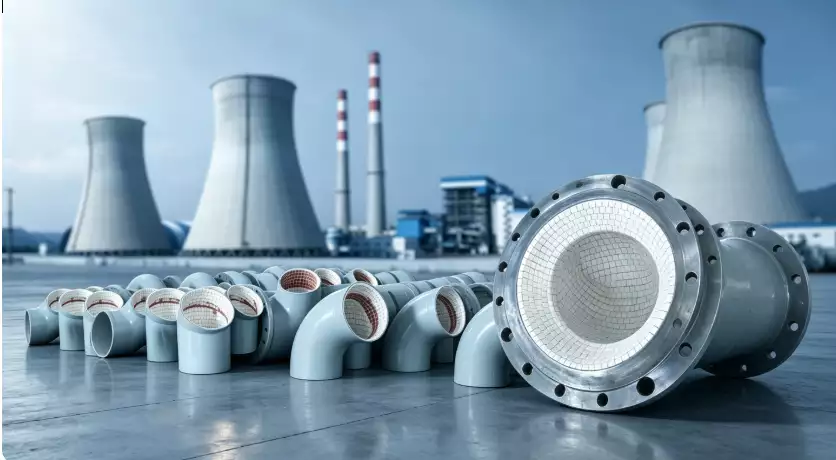
The lump‑coal block‑material conveying system is located at the front‑end coal‑handling workshop of thermal power plants. It is responsible for transporting large‑particle raw coal from stockyard to coal bunker and coal‑feeder equipment before coal enters the pulverizer. Large‑size lump coal features high hardness and strong impact property. When materials fall, slide and divert inside equipment, inner metal surfaces suffer combined damage from heavy‑particle impact and sliding abrasive wear. Without effective anti‑wear protection, chutes and hoppers will quickly thin and perforate, resulting in coal leakage and serious dust pollution. Wear‑resistant ceramic lining is applied for bucket‑wheel stacker‑reclaimer cylinder and disc, belt‑head hoppers, raw‑coal bunkers, coal‑feeder gate plates, coal drop chutes, and pulverizer outlet inclined pipes in this block‑coal conveying subsystem.
Bucket‑wheel stacker‑reclaimer is core stockyard equipment for coal stacking and reclaiming. Its disc and cylinder sections endure cyclic heavy impact from falling lump coal during continuous material‑reclaiming cycles. Original steel surfaces are prone to gouging, denting and local deformation, requiring frequent repair welding and shutdown maintenance. Laying modular ceramic composite liners over high‑stress impact zones of bucket‑wheel discs and inner cylinder walls disperses lump‑coal impact force, mitigates gouging‑type abrasive damage, and greatly extends major‑repair cycles of the whole stacker‑reclaimer machine. Custom‑cut ceramic tiles can fit curved contour surfaces perfectly to avoid gaps which become stress‑concentration points for accelerated local erosion.
Belt‑head hoppers receive lump coal discharged from the head end of belt conveyors; raw‑coal bunkers serve as large‑volume intermediate buffer storage for raw coal before feeding into coal feeders. The cone‑shaped discharge throat and inner wall of these hoppers and bunkers bear dual‑mode wear: long‑term static‑pressure friction from stacked coal piles and dynamic impact from incoming falling lump coal. Traditional carbon‑steel hoppers show severe wall‑thinning and local perforation at cone outlets. By pasting or bolt‑fixing ceramic liners on inner walls, especially for feeding‑inlet zones and cone transition sections, operators can resist both lump‑coal impact and sliding abrasion. The smooth dense ceramic surface also reduces wet‑coal adhesion, prevents coal bridging and material hang‑up inside bunkers, lowers manual cleaning frequency and guarantees stable coal‑supply flow rate toward coal feeders.
Coal‑feeder gate plates control raw‑coal feeding quantity entering pulverizers. Gate‑plate surfaces keep sliding contact with continuously‑flowing lump‑coal and fine‑coal mixture, suffering persistent two‑body abrasive wear. Ordinary steel gate plates wear thin quickly, leading to inaccurate opening‑and‑closing clearance, unstable coal‑feed rate and frequent gate‑plate replacement. Pasting high‑hardness ceramic wear blocks on the working surface of gate plates improves anti‑abrasion performance dramatically, stabilizes feeding‑control accuracy and reduces spare‑part consumption of coal‑feeder assemblies.
Coal drop chutes realize material diversion and transition transportation for lump‑coal conveying circuits; pulverizer outlet inclined pipes deliver initially‑crushed coal mixture toward subsequent pulverizing‑classification equipment. Material‑impact corners, bent sections and inclined‑pipe inner walls are high‑erosion vulnerable positions. Installing wear‑resistant ceramic lining for these positions resists lump‑coal and coarse‑coal‑particle concentrated scouring, prevents premature pipe‑wall burn‑through and coal‑leakage failures, stabilizes material‑flow trajectory and avoids equipment‑performance deterioration caused by deformed worn‑out metal surfaces.
The pneumatic conveying system is the core subsystem for pulverized‑coal preparation and ash‑slag transportation inside thermal power plants. After raw coal is ground inside pulverizers, high‑speed air‑pulverized‑coal mixed flow transports fine‑coal powder through pipelines toward boiler burners; meanwhile, fly‑ash, slag and desulfurization medium are conveyed by gas‑solid or gas‑liquid two‑phase flow in related pipelines. High‑velocity hard mineral particles produce strong centrifugal scouring on pipe walls, elbows, separators and equipment inner cavities. Wear‑resistant ceramic‑wear‑resistance‑parts cover pulverizer cylinder bodies, sections from pulverizer outlet to classifier, return‑powder pipes, pulverized‑coal delivery pipes, dust‑removal pipelines, flue‑gas duct walls, ash‑discharge pipes, slag‑discharge pipes and desulfurization pipes of this pneumatic system.
Inside coal pulverizer cylinders, raw coal completes impact‑grinding and rolling‑crushing. Inner cylinder walls suffer long‑term compound wear from coal‑particle rolling friction and steel‑ball or roller impact. Pipeline sections connecting pulverizer outlet to classifier carry high‑speed coarse‑and‑fine mixed pulverized‑coal flow; elbows and tee joints are the most severely‑worn spots. Laying targeted ceramic composite liners for pulverizer‑cylinder vulnerable zones and connecting‑pipeline inner walls can effectively resist persistent pulverized‑coal particle scouring, avoid pipeline perforation and pulverized‑coal leakage, maintain stable air‑pressure balance of pulverizing system and guarantee normal classification efficiency of the classifier.
Return‑powder pipes transport unqualified coarse pulverized‑coal particles back into pulverizer for re‑grinding; pulverized‑coal delivery pipes send qualified fine coal powder to boiler combustion units. Coarse coal powder inside return‑powder pipes features larger particle size and stronger impact ability, while fine pulverized‑coal in delivery pipes flows at extremely high velocity. Both types of pipelines face severe abrasive threats. Ceramic‑lined composite pipes adopted for these two kinds of pipelines greatly improve anti‑scouring capability, reduce wall‑thinning rate, extend pipeline service‑life, avoid pulverized‑coal leakage‑caused safety hazards, and guarantee stable fuel‑supply for boiler combustion.
Dust‑removal pipelines carry high‑speed dust‑laden flue‑gas; flue‑gas duct walls bear long‑time scouring from fly‑ash particles mixed in exhaust gas. Ash‑discharge pipes and slag‑discharge pipes handle high‑hardness ash‑slag particle medium, and desulfurization pipes convey slurry containing limestone particles with weak‑corrosive property. These pieces of equipment suffer combined damage of particle erosion and mild chemical corrosion. Applying wear‑resistant ceramic lining for inner walls of above‑mentioned pipelines and flue‑gas ducts can simultaneously solve both abrasive‑wear and corrosion‑aging problems, reduce maintenance frequency of flue‑gas‑and‑ash‑treatment system, and support stable operation of power‑plant environmental‑protection facilities.
Partial boiler auxiliary equipment of thermal power plants runs under ultra‑high‑temperature working conditions, facing combined threats of high‑temperature flue‑gas erosion, high‑speed particle scouring and thermal‑cycle fatigue stress. Traditional alloy steel components will produce creep deformation, surface oxidation and rapid abrasive thinning under long‑term ultra‑high‑temperature environment. Wear‑resistant ceramic‑wear‑resistance‑parts with special high‑temperature‑grade formula can keep stable mechanical performance under long‑term high‑temperature exposure, and are widely used for burner square nozzles, W‑flame burner cones, rear‑end flue‑gas ducts, air‑preheater baffles, air‑preheater support rods and pulverizer stationary rings.
Burner square nozzles and W‑flame burner cones are core components of boiler combustion chamber. High‑temperature pulverized‑coal‑air mixture sprays out through these components. Inner surfaces bear continuous scouring from high‑velocity pulverized‑coal particles and radiation heat from flame. Ordinary alloy‑steel nozzles and cones are easy to wear, deform and burn‑through, which will change pulverized‑coal ejection trajectory, worsen combustion efficiency and increase unplanned boiler‑shutdown risk. Adopting high‑temperature‑resistant ceramic lining for inner flow‑passage surfaces of burner square nozzles and W‑flame burner cones maintains original structural geometry under ultra‑high‑temperature environments, resists particle scouring and high‑temperature oxidation, stabilizes boiler combustion status and extends service‑life of key combustion components.
Rear‑end flue‑gas ducts are located at the downstream section of boiler combustion, where flue‑gas still retains relatively high temperature and carries a large amount of fly‑ash particles. Fly‑ash particles produce persistent abrasive scouring on duct inner walls, together with thermal‑expansion‑cold‑shrinkage cyclic stress. High‑temperature‑grade wear‑resistant ceramic lining installed for rear‑end flue‑gas duct inner walls effectively mitigates fly‑ash erosion damage, prevents duct‑wall thinning and air‑leakage, and guarantees stable flow field of post‑combustion flue‑gas toward denitrification, dust‑removal and desulfurization workshops.
Air‑preheater baffles adjust air‑volume distribution; air‑preheater support rods undertake structural‑support tasks inside the air‑preheater unit. Both components are immersed in high‑temperature dust‑laden flue‑gas environment for a long time, subject to fly‑ash particle scouring and high‑temperature oxidation. After long‑time operation, baffles will wear and deform, affecting air‑distribution accuracy; support‑rod cross‑section will thin due to erosion, threatening structural‑safety of air‑preheater equipment. Covering vulnerable surfaces of baffles and support rods with high‑temperature‑resistant ceramic‑wear‑resistance‑parts improves anti‑erosion and anti‑oxidation performance, stabilizes air‑preheater working performance and enhances overall equipment‑safety margin.
Pulverizer stationary rings are key grading components inside coal pulverizers. They work under mixed conditions of coal‑particle impact, sliding friction and moderate high‑temperature hot‑air environment. Traditional metal stationary‑ring surfaces wear quickly, which will change pulverizer internal flow‑field and particle‑grading effect, resulting in unqualified pulverized‑coal fineness and decreased pulverizing‑efficiency. Pasting high‑strength high‑temperature‑resistant ceramic lining for working surfaces of pulverizer stationary‑rings resists coal‑particle continuous scouring, keeps original structural profile, guarantees pulverized‑coal fineness index and improves overall pulverizer operational stability.
Thermal‑power‑plant working‑conditions integrate particle impact, high‑speed abrasive scouring, high‑temperature thermal radiation and slight medium‑corrosion. Compared with traditional carbon steel, alloy‑steel, overlay‑welding and cast‑iron anti‑wear parts, wear‑resistant ceramic‑wear‑resistance‑parts show multi‑dimensional prominent advantages for coal‑handling, pulverizing, flue‑gas‑ash‑treatment and boiler‑auxiliary‑equipment systems of power plants.First, excellent wear‑resistance and ultra‑long service‑cycle. High‑purity alumina ceramic material reaches HRA85‑90 hardness, far higher than ordinary alloy steel. Under power‑plant abrasive working‑conditions, reasonably‑installed ceramic lining achieves service‑life 5‑10 times longer than traditional metal liners, greatly reducing equipment disassembly, maintenance and spare‑part replacement frequency.Second, outstanding high‑temperature adaptability and chemical stability. High‑temperature‑grade ceramic lining can operate stably for long‑term under temperature range from room‑temperature up to 800℃, resist high‑temperature oxidation and weak acid‑alkali corrosion from flue‑gas, ash‑slag and desulfurization medium, and can satisfy diverse working‑condition requirements from normal‑temperature coal‑handling workshops to ultra‑high‑temperature boiler auxiliary‑equipment zones.Third, smooth inner‑surface characteristic prevents material hanging‑up and blockage. Dense low‑friction ceramic surface reduces adhesion of wet raw‑coal, pulverized‑coal, fly‑ash and desulfurization slurry. It effectively avoids coal‑bunker bridging, pulverized‑coal pipeline blockage and material‑deposition inside flue‑gas ducts, lowers manual cleaning workload and guarantees unobstructed material‑flow and gas‑flow for each production subsystem.Fourth, remarkable full‑life‑cycle comprehensive‑cost‑reduction benefit. Even though the initial procurement cost of ceramic‑wear‑resistance‑parts is higher than ordinary metal liners, thermal‑power enterprises can save large‑scale expenditure on spare‑part purchasing, maintenance‑manpower input, and most importantly, huge economic loss caused by unplanned shutdown and power‑generation reduction. A large number of site‑renovation practices of thermal‑power plants verify that the comprehensive operation‑and‑maintenance cost of vulnerable equipment can drop by over 55% after adopting ceramic‑lining anti‑wear upgrading.Fifth, flexible customized‑manufacturing and diversified installation solutions. According to different power‑plant equipment shapes (flat‑plate hopper walls, curved‑surface pipes, cone‑shaped burners, special‑shaped stationary‑rings, support rods and baffles), wear‑resistant ceramic‑wear‑resistance‑parts can be tailor‑made into ceramic tiles, curved segments, special‑shape blocks and composite boards. Multiple installation technical routes including high‑temperature‑special‑ceramic‑adhesive bonding, bolt‑through mechanical fastening and vulcanized composite molding can satisfy different requirements of impact‑load, temperature‑grade and medium‑corrosion. Partial local‑repair‑and‑replacement is supported; there is no need to replace whole‑set liner when only small‑area local damage occurs, further improving the economy of power‑plant equipment maintenance.
The global thermal‑power industry is continuously advancing toward high‑availability, energy‑saving, low‑emission and long‑cycle‑safe‑operation targets. Power‑plant coal‑handling, pulverizing, flue‑gas‑denitrification‑desulfurization‑dust‑removal and boiler‑auxiliary systems put forward higher‑level requirements for anti‑wear and anti‑high‑temperature performance of equipment components. Traditional metal anti‑wear components can hardly meet the operation‑demands of modern large‑capacity high‑parameter thermal‑power units. At present, more and more thermal‑power enterprises are carrying out anti‑wear‑renovation for heavily‑worn positions of conveying, pulverizing and boiler‑auxiliary systems by adopting ceramic‑lining solutions. Practical site‑operation‑feedback from multiple power‑plant‑renovation‑projects has fully verified its prominent value for extending equipment service‑life, improving unit‑availability‑rate and cutting comprehensive operation‑and‑maintenance‑expense.Looking forward, with continuous material‑upgrading of toughened high‑temperature‑resistant alumina ceramic composite products, ceramic‑wear‑resistance‑parts will gain further popularization inside thermal‑power‑plant workshops. Beyond existing application‑equipment covered in this article, ceramic lining technology will expand toward more power‑plant auxiliary‑scenarios such as circulating‑fluidized‑bed boiler internal components, waste‑heat‑recovery pipelines and solid‑waste‑treatment conveying‑equipment, becoming indispensable core anti‑abrasion and anti‑high‑temperature material for safe‑and‑efficient operation of modern thermal‑power‑generation units.
Inside thermal‑power‑plant production systems, general‑conveying systems, lump‑coal block‑material‑conveying systems, pneumatic pulverized‑coal conveying systems and ultra‑high‑temperature boiler‑auxiliary‑equipment contain a large quantity of heavily‑worn key equipment: ceramic drum‑rubber‑coated conveyor drums; bucket‑wheel stacker‑reclaimer cylinder and disc, belt‑head hoppers, raw‑coal bunkers, coal‑feeder gate plates, coal drop chutes, pulverizer outlet inclined pipes; pulverizer cylinder bodies, pulverizer‑outlet‑to‑classifier pipelines, return‑powder pipes, pulverized‑coal delivery pipes, dust‑removal pipelines, flue‑gas duct walls, ash‑discharge pipes, slag‑discharge pipes, desulfurization pipes; burner square nozzles, W‑flame burner cones, rear‑end flue‑gas ducts, air‑preheater baffles, air‑preheater support rods and pulverizer stationary rings. All these components suffer compound damage including particle impact, abrasive scouring, high‑temperature thermal‑erosion and medium‑corrosion. Traditional metal anti‑wear‑measures show obvious bottlenecks in practical power‑plant production.Wear‑resistant ceramic‑wear‑resistance‑parts provide targeted anti‑wear and anti‑high‑temperature protection for above‑mentioned thermal‑power‑plant equipment. It brings comprehensive benefits including greatly‑prolonged component‑service‑life, reduced shutdown‑maintenance frequency, smooth material‑and‑gas‑flow‑condition and reduced full‑life‑cycle comprehensive‑cost. For modern thermal‑power‑enterprises, implementing anti‑wear‑renovation by adopting qualified ceramic‑lining‑products is not merely partial‑component‑upgrading work, but also an important technical‑approach to guarantee unit‑safe‑continuous‑operation, improve power‑generation‑availability‑rate and lift overall economic‑benefit of power‑plants.

Подайте ваш запрос,
Мы свяжемся с вами как можно скорее.

Sanxin New Materials Co., Ltd. специализируется на производстве и продаже керамических бусин и деталей, таких как шлифовальные средства, струйные бусины, подшипник, часть конструкции, керамические износостойкие вкладыши, наночастицы нанопорошка


 Английский язык
 Английский язык
 Русский язык
 Французский язык
 На испанском языке
 На португальском языке
 Арабский язык