


Modern steel‑making and sintering production represents one of the most demanding heavy‑duty industrial environments. Throughout the complete steel‑making workflow, raw iron ore, sinter feed, pellet materials, coke fines and various auxiliary mineral materials are continuously transported, batched, mixed and sintered. These granular and powdery raw materials carry high hardness, sharp particle edges, mixed dust, and occasional high‑temperature waste gas flow, bringing severe abrasive scouring, particle impact and mild thermal corrosion to large sets of processing equipment inside steel mills. Conventional carbon steel plates, manganese steel liners and hard‑facing welding layers are widely adopted as original factory anti‑wear measures, yet they show obvious drawbacks under real‑world metallurgical working conditions. Metal liners suffer rapid thinning, local perforation, deformation and crack propagation under persistent particle impact. Unplanned shutdown for repairing or replacing worn components becomes a frequent occurrence, which cuts down overall equipment operating rate, raises spare‑part procurement expenditure and generates considerable production loss for steel enterprises.As advanced anti‑abrasion consumables for heavy‑industry scenarios, wear‑resistant ceramic‑wear‑resistance‑parts are manufactured from high‑purity alumina corundum ceramics. The material delivers exceptional hardness, outstanding erosion resistance, moderate high‑temperature tolerance and stable chemical inertness. When properly installed via high‑strength ceramic adhesive, bolt‑on assembly or vulcanized composite structures, these ceramic components can withstand long‑term bombardment from mineral particles in steel workshops. Compared with traditional manganese steel liners, well‑installed ceramic lining can multiply component service life by 5‑12 times in many heavily‑worn metallurgical positions. More and more integrated steel plants and sintering workshops are retrofitting key vulnerable equipment with wear‑resistant ceramic‑wear‑resistance‑parts across three core production modules: material feeding & conveying systems, raw‑material batching systems, and sintering processing systems.This SEO article comprehensively sorts out the detailed application scope of wear‑resistant ceramic lining inside steel mill workshops, enumerates specific equipment positions within feeding, batching and sintering processes, analyzes real‑world pain points solved by ceramic solutions, and summarizes tangible economic benefits for metallurgical manufacturers. It can serve as practical technical reference for steel‑plant equipment managers when planning anti‑wear renovation projects.
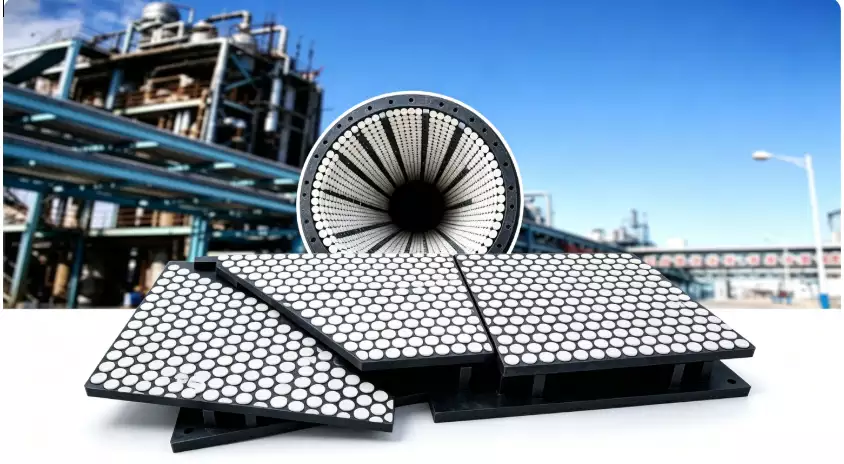
The material feeding and conveying system acts as the front‑end logistics hub of the whole steel plant. It undertakes receiving, stockpiling, transferring and distributing bulk iron ore, coke, flux and return sinter fines. A large quantity of transfer equipment works under cyclic heavy‑load conditions: bulk ore lumps and sharp mineral granules continuously drop, slide and collide against metal inner surfaces. Without effective anti‑wear protection, hoppers and transfer chutes will develop penetrating holes within several months. Wear‑resistant ceramic‑wear‑resistance‑parts are extensively deployed for bucket wheel discs, material hoppers, storage silos, belt conveyor skirt boards, trolley three‑way chutes, receiving hoppers, together with ceramic drum rubber coating for conveyor pulleys in this feeding‑conveying unit.
Bucket‑wheel reclaimer discs operate under cyclic impact from stacked bulk ores. Ore lumps fall directly onto disc surfaces during stock‑yard reclaiming cycles, generating combined impact wear and sliding abrasive wear. Original steel disc surfaces wear quickly; local gouging and deformation often appear. Repair welding work requires frequent production pauses. Laying modular ceramic liners over high‑stress zones of bucket wheel discs disperses particle impact force, mitigates gouging damage, and greatly extends overhaul intervals for the bucket‑wheel reclaimer machine. Custom‑cut ceramic composite tiles fit curved disc contours perfectly, avoiding gaps that become stress concentration points for accelerated local erosion.
Material hoppers and storage silos serve as intermediate buffer containers for different grades of raw ore inside steel‑plant stock houses. Inner walls, especially cone‑shaped discharge sections, endure long‑term static pressure friction from stacked mineral bulk plus dynamic impact from falling incoming feeds. Traditional manganese‑steel lined hoppers show heavy wear at cone outlets, requiring periodic patch welding. By pasting or bolting ceramic liners onto hopper and silo inner walls, particularly at the feeding throat and cone transition zones, operators can resist both sliding abrasion and material‑drop impact. Smooth ceramic surfaces also minimize sticky ore buildup, reducing manual cleaning workload for material hang‑up inside silos. For large‑volume silos, segmented ceramic liner modules simplify on‑site installation and partial replacement when localized damage happens.
Belt‑conveyor skirt boards sit along both sides of transfer‑point belt chutes. Their function is to prevent material spill‑over during high‑volume ore transportation. Fine ore powder and small ore fragments continuously grind against skirt‑board inner faces. Ordinary steel skirt boards thin rapidly, resulting in large gaps between skirt board and belt, massive material leakage and severe site dust pollution. Installing ceramic composite liners on skirt‑board inner sides improves anti‑abrasion performance dramatically. Many steel mills report that ceramic‑protected skirt boards achieve service‑life extension of 4‑7 times compared with original steel plates, lowering spillage‑related housekeeping burden at transfer stations.
Trolley three‑way chutes realize material diversion for multi‑path raw‑material distribution. Material particles strike and slide across inner walls, and branching corners suffer concentrated scouring. Receiving hoppers directly accept falling bulk materials discharged from upstream conveyors, making the hopper bottom and side‑wall impact zones the fastest‑wearing sections of the feeding circuit. Wear‑resistant ceramic lining covers these high‑erosion corners and impact zones inside three‑way chutes and receiving hoppers. It prevents premature perforation and material leakage, stabilizes material flow trajectories and avoids flow‑pattern distortion caused by worn‑out deformed metal surfaces.
Conveyor drums are critical power transmission components for bulk‑material belt transportation in steel‑plant feeding circuits. Traditional pure‑rubber drum lagging wears fast under mixed ore‑dust friction, leading to belt slippage, belt deviation and unstable conveying capacity. Ceramic drum rubber coating is a composite anti‑wear and anti‑skid solution combining elastic rubber substrate and embedded hard‑alumina ceramic particles. The exposed ceramic particles enhance friction coefficient between drum shell and conveyor belt to eliminate slippage; meanwhile, ceramic components resist abrasive damage brought by mineral dust trapped between belt and drum surface. This composite coating protects drum metal matrix, prolongs drum overhaul cycles and also helps extend service life of expensive steel‑cord conveyor belts in heavy‑duty steel‑plant material‑handling lines.
The batching system undertakes proportioning, homogenizing and pelletizing work for sintering raw mix. Multiple types of iron‑bearing ore, flux, coke fines and return sinter are accurately metered and delivered into mixing equipment. Inside mixing drums and discs, materials keep tumbling, rubbing and colliding at moderate temperature with certain moisture content. Metal surfaces of mixing equipment suffer compound wear from particle friction plus mild damp‑material corrosion. Ceramic lining products have been widely adopted for mix silos, primary mixing drums, secondary mixing drums, mixing discs, mixing‑cylinder scrapers and pelletizing discs within steel‑plant batching workshops.
Mixed‑material silos store prepared sinter raw mixture before entering mixing rotary drums. The blended mineral mixture contains fine particles and a certain proportion of water vapor, creating combined abrasive and slightly corrosive working conditions for silo inner walls. Ceramic lining resists both particle scouring and damp‑raw‑material corrosion. Smooth ceramic surfaces reduce adhesion of wet mixed ores, preventing bridging and material hang‑up inside silos, ensuring stable and consistent discharging flow rate toward downstream mixing equipment.
Primary and secondary mixing drums are large rotating cylindrical devices. Raw sinter blends continuously tumble inside rotating drums to complete wet mixing and pre‑granulation. Drum inner linings endure persistent sliding friction from rolling mineral mixtures. Partial areas also receive material‑drop impact at feed inlet sections. Traditional steel plates inside mixing drums wear gradually; worn rough inner surfaces aggravate material sticking and make mixing efficiency decline. Installing bolt‑fixed ceramic composite liners on vulnerable zones of primary‑ and secondary‑mixing‑drum inner walls effectively improves anti‑wear performance. Ceramic‑rubber‑steel three‑in‑one composite liners are often preferred for mixing‑drum applications, as intermediate rubber layers absorb tumbling‑material impact energy to prevent brittle ceramic tile chipping under cyclic material pounding.
Mixing discs perform high‑speed agitation of sinter raw materials. Mixing‑cylinder scrapers continuously scrape material accumulated on equipment inner surfaces. Pelletizing discs roll moist mineral fines into green pellets for subsequent sintering or pellet‑firing processes. All these rotating or reciprocating components face continuous friction from wet granular feeds. For mixing‑disc bottom plates and side rims, partial ceramic‑steel composite liner installation mitigates surface abrasion. For scraper working faces, pre‑fabricated ceramic wear blocks enhance service life compared with hard‑weld alloy scrapers. On pelletizing‑disc inner rims and bottom zones, ceramic lining reduces pellet‑mixture adhesion, keeps disc surface geometry stable, helps maintain green‑pellet size consistency and cuts down frequency of manual disc‑surface cleaning work.
The sintering system constitutes the core thermal processing unit of steel‑plant sinter workshops. After batching and mixing, green material beds go through ignition and high‑temperature sintering. Large volumes of hot sinter fines, high‑temperature dust‑laden exhaust gas are generated. Post‑sinter material‑sorting, dust‑collection and gas‑transport equipment suffer combined threats of high‑temperature particle erosion, thermal cycling and abrasive dust scouring. Wear‑resistant ceramic lining is applied for vibrating‑screen under‑product hoppers, raw‑material transfer chutes, cyclone dust collectors and connected pipelines, as well as fan impellers inside sintering exhaust‑gas treatment circuits.
After sinter cake crushing, vibrating screens classify sinter products. Screen undersize materials drop into underlying receiving hoppers. These hoppers and downstream transfer chutes carry hot, sharp‑edged sinter fines. Hot‑particle impact plus thermal fatigue quickly consume ordinary metal hopper and chute liners. High‑temperature‑grade wear‑resistant ceramic lining is suitable for these positions. Ceramic materials retain good hardness under working temperatures of 200‑350℃. Lined hoppers and chutes resist hot‑sinter‑fines scouring, avoid frequent burn‑through and leakage, and reduce hot‑dust spill‑over risks inside sinter workshops.
Cyclone dust collectors separate sinter‑process dust particles from high‑temperature exhaust gas streams. Inside cyclone barrels, cones and connected gas pipelines, high‑speed dust‑gas mixtures generate strong centrifugal scouring against inner metal walls. Cone sections and pipeline elbow segments represent the most severely‑worn locations. When cyclone inner walls wear thin, dust‑separation efficiency drops obviously, and un‑separated coarse dust flows into subsequent exhaust fans to accelerate fan‑component damage. Installing wear‑resistant ceramic lining on cyclone inner surfaces and dust‑gas pipeline elbows maintains complete geometric profiles of cyclone equipment, guarantees stable dust‑removal efficiency, and extends service life of the whole dust‑collection circuit.
Exhaust‑gas fans, circulating fans and dust‑exhaust fans serve sintering production. Fan impeller blades directly contact high‑speed dust‑bearing hot airflow. Hard sinter‑dust particles continuously scour blade surfaces, producing abrasive thinning, pitting and unbalanced blade mass. Impeller imbalance triggers strong equipment vibration, forcing periodic fan overhaul. Bonded or welded wear‑resistant ceramic tiles are pasted onto impeller blade working surfaces, back‑plates and root transition zones. Ceramic layers shield metal substrate from dust‑particle erosion, greatly prolong impeller service intervals and lower fan‑vibration‑related failure risks for sinter‑plant exhaust‑gas systems.
Metallurgical production environments combine heavy particle impact, abrasive scouring, occasional medium‑level temperature and damp mineral materials. Compared with traditional manganese‑steel plates, overlay welding, rubber liners and cast‑iron wear parts, wear‑resistant ceramic‑wear‑resistance‑parts deliver multi‑dimensional performance strengths when deployed across feeding, batching and sintering systems of steel mills.First, prominent anti‑wear performance and long service cycles. High‑purity alumina ceramic reaches HRA85‑90 hardness, far surpassing common structural steel and manganese steel. Under metallurgical abrasive conditions, properly installed ceramic lining achieves service‑life 5‑12 times longer than ordinary steel liners. It sharply cuts down frequency of equipment disassembly, repair and spare‑part replacement.Second, adaptability to mixed complex working‑condition factors. Quality ceramic lining tolerates continuous working temperature up to 350℃, withstands mild damp‑mineral corrosion, and matched composite structures (ceramic‑rubber‑steel three‑in‑one liners) absorb material‑drop impact energy to overcome ceramic brittleness risks, making them fit for mixing drums, silos and transfer hoppers with both impact and abrasion loads.Third, smooth inner‑surface property reduces material sticking and blocking. Dense low‑friction ceramic surfaces minimize adhesion of wet sinter mixture, fine ore and sinter dust. This reduces material hang‑up, bridging and blockage inside hoppers, silos, chutes and cyclone equipment, lowers regular manual cleaning workload and stabilizes material‑flow continuity for steel‑plant process lines.Fourth, remarkable comprehensive‑cost reduction benefit throughout full life‑cycle. Even though initial procurement investment of ceramic‑wear‑resistance‑parts is higher than ordinary steel liners, steel enterprises can save large sums from spare‑part purchases, maintenance‑manpower expenditure and most importantly, economic loss caused by unplanned production shutdown. For large‑scale sintering workshops, many practical renovation projects prove that total comprehensive operating expense for vulnerable equipment can drop by more than 55% after adopting ceramic‑lining anti‑wear upgrading.Fifth, flexible customized‑manufacturing and diversified installation solutions. According to different steel‑plant equipment shapes (flat plates, curved drums, cone cyclones, special‑shape impellers), wear‑resistant ceramic‑wear‑resistance‑parts can be tailor‑made into tiles, blocks, curved segments, pre‑assembled composite boards. Multiple installation options including high‑temperature ceramic‑adhesive bonding, bolt‑through mechanical fastening, and vulcanized composite molding satisfy different impact‑load and temperature‑grade requirements across feeding, batching and sintering equipment. Partial‑local‑replacement is supported; there is no requirement to replace the whole set of liner when only small‑area damage occurs, further improving economy of equipment maintenance.
Global steel‑making industry keeps moving toward high‑capacity, energy‑saving, low‑emission and long‑cycle equipment‑operation targets. Sinter and pellet workshops are continuously pursuing higher equipment operation rates and lower maintenance‑related production‑interruption rates. Traditional metal anti‑wear components can hardly satisfy the rising requirement of modern large‑capacity sintering production lines. At present, more and more metallurgical enterprises are retrofitting vulnerable positions inside feeding‑conveying, batching‑mixing and sinter‑dust‑removal systems with ceramic lining solutions. Practical site feedback from numerous steel‑plant renovation projects has verified its prominent value for extending equipment service life, stabilizing process flow and cutting comprehensive operation‑and‑maintenance expenditure.Looking forward, along with material‑form upgrading of ceramic composite products, impact‑resistant toughened alumina ceramic materials and multi‑layer composite liner structures will get further promotion inside metallurgical workshops. Beyond existing application equipment covered in this article, wear‑resistant ceramic‑wear‑resistance‑parts will expand toward more auxiliary systems of steel mills, such as blast‑furnace coal‑injection pipelines, slag‑handling transfer equipment and waste‑heat recovery dust‑collecting devices, becoming indispensable core anti‑abrasion material for high‑efficiency metallurgical production.
Inside steel‑mill sinter workshops, material‑feeding‑conveying systems, raw‑material batching systems and sintering systems contain a large number of heavily‑worn equipment: bucket‑wheel discs, various hoppers and silos, belt skirt boards, trolley three‑way chutes, ceramic drum rubber‑coated conveyor drums; mixing silos, primary‑ and secondary‑mixing drums, mixing discs, scraper assemblies, pelletizing discs; vibrating‑screen under‑product hoppers, raw‑material transfer chutes, cyclone dust collectors, dust pipelines and sinter‑system fan impellers. All these key components face severe combined damage from mineral‑particle impact, abrasive scouring, damp‑material corrosion and medium‑temperature exhaust‑gas erosion. Traditional steel‑based wear‑resistant measures expose many bottlenecks in practical production.Wear‑resistant ceramic‑wear‑resistance‑parts offer targeted anti‑wear protection for above‑mentioned metallurgical equipment. They bring obvious benefits including greatly‑prolonged component service life, reduced shutdown‑maintenance frequency, smoother material flow and lower full‑cycle comprehensive cost. For modern steel enterprises, carrying out anti‑wear renovation by deploying qualified ceramic‑lining products is not merely partial‑component upgrading, but also an effective technical path to guarantee continuous stable sinter‑plant production and improve overall economic benefit of steel‑making workshops.

Подайте ваш запрос,
Мы свяжемся с вами как можно скорее.

Sanxin New Materials Co., Ltd. специализируется на производстве и продаже керамических бусин и деталей, таких как шлифовальные средства, струйные бусины, подшипник, часть конструкции, керамические износостойкие вкладыши, наночастицы нанопорошка


 Английский язык
 Английский язык
 Русский язык
 Французский язык
 На испанском языке
 На португальском языке
 Арабский язык