


The cement manufacturing industry is one of the most abrasive and equipment-intensive industrial sectors worldwide. The entire cement production process involves continuous crushing, grinding, conveying, and gas-solid separation of high-hardness mineral materials, including limestone, raw ore, coal powder, and cement clinker. These production procedures cause persistent particle scouring, strong friction, and frequent impact wear on metal equipment, which inevitably leads to thinning walls, component deformation, material leakage, dust emission, and frequent equipment shutdowns. For cement plants, unplanned maintenance and equipment replacement due to severe wear are the primary causes of low production efficiency, high operational costs, and unstable production cycles.Traditional anti-wear solutions such as carbon steel liners, rubber liners, and epoxy coatings can no longer meet the long-term and high-load working requirements of modern cement production lines. Steel plates wear rapidly under continuous mineral scouring, ordinary rubber liners fail to resist high-temperature and high-speed particle impact, and conventional coatings are prone to peeling and cracking. In contrast, wear-resistant ceramic lining made of high-purity alumina ceramic possesses superior physical and chemical properties, including ultra-high hardness, excellent abrasion resistance, high-temperature stability, corrosion resistance, and strong impact resistance. Its service life is 5–10 times longer than ordinary steel liners, making it the most reliable anti-wear material for cement production equipment.Wear-resistant ceramic lining has achieved full-scene popularization in core cement production systems. This article comprehensively sorts out its detailed application scope in limestone crushing systems, raw fuel pre-homogenization systems, raw mill systems, and fuel steel ball mill systems, clarifies applicable equipment components, analyzes practical application values, and provides professional references for cement enterprises to upgrade equipment anti-wear systems, reduce maintenance costs, and improve continuous production capacity.
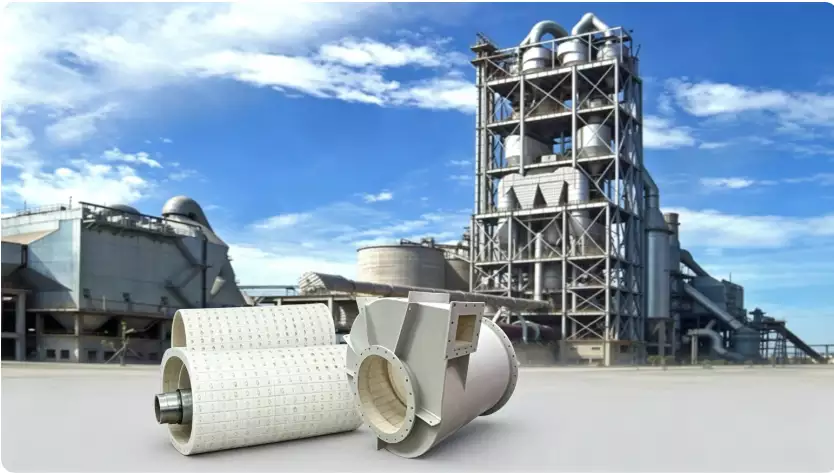
As the front-end process of cement production, limestone crushing and raw fuel pre-homogenization determine the stability of subsequent grinding and calcination procedures. Limestone features high hardness and strong abrasive performance. During feeding, crushing, conveying, stacking, and homogenization, raw materials continuously impact and rub against conveying and buffering equipment, resulting in the most severe primary wear of the entire production line. Wear-resistant ceramic lining and ceramic drum rubber coating are mainly applied to three core equipment types in this system: chutes, material hoppers, and conveyor drums, solving the wear pain points of front-end material handling equipment in a targeted manner.
Chutes are indispensable connecting and transitional equipment in limestone crushing and pre-homogenization workshops, undertaking the sliding transportation of crushed limestone aggregates, auxiliary raw materials, and blended fuels. In actual operation, bulk mineral materials slide down along the inclined chute inner wall at a certain speed, forming continuous cutting wear and gravitational impact on the metal base. Ordinary carbon steel chutes will suffer obvious wall thinning after 3 to 6 months of continuous operation, and local perforation often occurs in severe cases, triggering material leakage, on-site dust pollution, and frequent shutdown maintenance.Laying integrated wear-resistant ceramic lining on the inner wall of cement chutes thoroughly optimizes the material contact interface. The high-density, high-hardness ceramic surface effectively resists the cutting force of sharp limestone particles and buffers continuous material impact. Meanwhile, the ultra-smooth surface of ceramic lining greatly reduces material adhesion and accumulation, effectively avoiding chute blockage caused by sticky materials and secondary wear problems. Field application data of multiple large cement plants shows that ceramic-lined chutes can maintain stable operation for more than 5 years, which drastically reduces the frequency of equipment replacement, cuts down manual maintenance costs, and significantly improves the continuous operation rate of the front-end crushing and homogenization system.
Raw material and fuel hoppers are key buffer and storage equipment in the pre-homogenization system, responsible for temporary storage, uniform feeding, and material buffering of limestone, sandstone, and mixed fuels. The inner wall of the hopper bears dual wear of long-term static pressure friction from stacked materials and dynamic impact from falling bulk materials. Especially the cone section and feeding port at the bottom of the hopper are the most severely worn areas, where materials are highly concentrated and impact intensity is maximized.Traditional all-steel hoppers are prone to depression, deformation, and local perforation in the cone part after long-term operation, requiring regular welding repair and integral replacement. By pasting high-strength wear-resistant ceramic lining on the inner wall of the hopper, especially the vulnerable cone and feeding area, the equipment’s impact resistance and friction resistance are greatly enhanced. In addition, ceramic lining has excellent moisture resistance and weak acid-base corrosion resistance, which can adapt to the humid working environment of outdoor pre-homogenization yards, prevent metal equipment rusting and corrosion wear, and stabilize the overall operating state of the hopper. Statistics show that ceramic lining transformation can reduce the annual maintenance cost of cement plant hopper equipment by more than 60%.
Conveyor drums are the core power components of material conveying lines in crushing and pre-homogenization systems. Long-term friction between the metal drum and conveyor belt, as well as continuous scouring of residual mineral particles, easily causes drum surface wear, belt skidding, and belt deviation. Once skidding occurs, the material conveying speed will be unstable, and severe equipment jamming and shutdown failures may happen, seriously affecting the homogenization efficiency of raw materials and fuels.Ceramic drum rubber coating is a composite anti-wear and anti-skid solution customized for cement conveyor drums. It combines high-elastic wear-resistant rubber substrate and high-hardness alumina ceramic particles, integrating the flexibility of rubber and the super wear resistance of ceramics. The protruding ceramic particles on the coating surface effectively increase the friction coefficient between the drum and the belt, completely solving the problems of belt skidding and deviation, and improving material conveying efficiency and stability. At the same time, the ceramic particle layer can resist the continuous impact and friction of raw material particles, protect the drum metal matrix from wear, and extend the service life of both the drum and the conveyor belt.Compared with traditional pure rubber coating, ceramic drum rubber coating has stronger anti-aging, anti-abrasion and anti-tearing performance, and can adapt to 24-hour high-load continuous operation of cement production lines. It is currently the most cost-effective anti-wear and anti-skid accessory for conveyor drums in cement crushing and pre-homogenization systems.
The raw mill system is the core unit for raw meal preparation in cement production, which grinds mixed raw materials such as limestone, sandstone, and iron powder into qualified fine raw meal for subsequent clinker calcination. The system consists of vertical raw mills, powder separators, cyclone separators, and connecting conveying pipelines. During operation, high-speed gas-solid mixed flows carry a large number of mineral particles to scour equipment inner walls, causing extremely serious abrasive wear. Wear-resistant ceramic lining is widely applied in multiple key vulnerable parts of the raw mill system, including powder separator guide vanes, separator cones, vertical mill-to-cyclone connecting pipelines, cyclone cylinder bodies, fuel mill matching components, separator shells, inner cones, and pulverized coal pipelines, realizing full-coverage anti-wear protection for the raw meal grinding system.
The powder separator undertakes the key process of raw meal particle grading, separating qualified fine powder and unqualified coarse powder to ensure the fineness uniformity of finished raw meal. The internal airflow of the separator is complex and the particle flow speed is high, making guide vanes, outer shell, and inner cone the most vulnerable components.Guide vanes control the internal airflow direction and particle grading track. Long-term high-speed particle impact will cause blade wear, deformation and angle offset, directly reducing grading accuracy, leading to unqualified raw meal fineness, and increasing fan energy consumption. Pasting wear-resistant ceramic lining on the surface of guide vanes can effectively resist particle scouring, maintain the original structural angle and integrity of blades, stabilize grading quality, and avoid production quality fluctuations caused by component wear.The separator cone and inner cone are key areas for coarse powder collection and backflow. The material concentration in this area is extremely high, and continuous concentrated particle scouring will quickly wear through the metal cone wall, resulting in coarse powder leakage and reduced grinding efficiency. The high-hardness ceramic lining installed on the cone inner wall can withstand long-term high-concentration particle impact and scouring, maintain the tightness and structural stability of the cone body, and ensure the normal circulation of coarse and fine powder inside the separator.The separator outer shell bears long-term circulating material friction all year round. Overall laying of ceramic lining on the shell inner wall realizes full anti-wear coverage, avoids local thinning and damage of the shell, extends equipment service life, and reduces daily maintenance frequency.
The connecting pipeline from vertical mill to cyclone separator and all pulverized coal conveying pipelines are important channels for gas-solid material transmission in the raw mill system. High-speed flowing raw meal and coal powder particles cause strong scouring on pipeline bending sections and straight sections, easily leading to pipeline wall thinning, perforation and air leakage. Pipeline air leakage will disrupt system air pressure balance, reduce material conveying efficiency, and increase the operating load and energy consumption of exhaust fans.Laying wear-resistant ceramic lining on the inner wall of all grinding system pipelines can effectively resist high-speed particle scouring, eliminate pipeline wear and air leakage failures, and stabilize material conveying status. The smooth ceramic surface also reduces material adhesion and pipeline blockage, lowers the frequency of manual pipeline cleaning, and saves a lot of labor and time costs for enterprise operation and maintenance.As the core gas-solid separation equipment, the cyclone cylinder relies on centrifugal force to separate raw meal powder from airflow. The cylinder wall and cone part bear strong centrifugal particle scouring, with far higher wear intensity than ordinary equipment. The application of wear-resistant ceramic lining in cyclone cylinders prevents equipment deformation and separation efficiency reduction caused by wall wear, ensures stable gas-solid separation effect, and improves the raw meal collection rate of the grinding system.
The fuel steel ball mill is an important auxiliary equipment of the raw mill system, specially used to grind raw coal into fine pulverized coal that meets calcination standards. During the grinding process, steel ball impact and coal powder friction cause continuous wear on supporting grading and conveying equipment. The key vulnerable parts include the matched powder separator shell, inner cone, pulverized coal pipeline and powder return pipe.The finely ground coal powder has small particle size and high flow speed, causing persistent scouring on separator inner walls and conveying pipelines. Ceramic lining installed on the inner wall of the fuel mill separator shell and inner cone resists fine coal powder scouring, maintains separator structural stability, and guarantees accurate pulverized coal fineness grading. At the same time, ceramic protection for pulverized coal pipelines and powder return pipes prevents pipeline wear, coal powder leakage and material blockage, ensures stable pulverized coal circulation in the fuel grinding system, and provides continuous and stable fuel supply for cement clinker calcination.
The fuel steel ball mill system is an independent core unit for cement plant fuel preparation, directly determining the quality and supply stability of calcination pulverized coal. Different from raw meal grinding, coal powder grinding features finer particles, higher fluidity and higher internal system temperature, leading to more lasting and concealed equipment wear. Wear-resistant ceramic lining has exclusive and targeted application schemes in fuel mill systems, covering four core vulnerable parts: powder separator shell, inner cone, pulverized coal pipeline, and powder return pipe, forming a complete anti-wear protection system for coal powder preparation.
The fuel mill powder separator is dedicated to coal powder grading, separating unqualified coarse coal powder and qualified fine coal powder. Finer coal powder particles have stronger penetration and scouring performance, causing uniform and long-term micro-wear on the metal wall of the separator shell and inner cone. Long-term operation will lead to wall thinning, reduced structural strength and equipment deformation, affecting grading accuracy and system stability.High-purity wear-resistant ceramic lining is adopted for overall lining protection of fuel mill separators. Its super wear resistance effectively resists persistent fine coal powder scouring, while the dense and smooth surface avoids coal powder adhesion and accumulation, reducing the risk of coal powder spontaneous combustion caused by material deposition. In addition, ceramic lining has excellent high-temperature resistance, which can adapt to the high-temperature working environment of coal grinding systems, avoid aging and failure of traditional anti-wear materials, and ensure long-term stable operation of separator equipment.
Pulverized coal pipelines are responsible for conveying finished fine coal powder to the calcination system, while powder return pipes are circulation channels for unqualified coarse coal powder. These two types of pipelines bear the core material circulation work of the fuel mill system with completely different wear characteristics. The coarse coal powder in the return pipe has large particle size and high hardness, causing strong impact and cutting wear on the pipeline wall; the fine coal powder in the conveying pipeline flows at high speed, forming high-frequency friction scouring.Targeted ceramic lining solutions are adopted for different pipelines. High impact-resistant ceramic lining is used for powder return pipes to buffer particle impact force and resist cutting wear; high-density smooth ceramic lining is applied to fine coal powder pipelines to reduce friction resistance and prevent pipeline wall thinning and perforation. After ceramic transformation, the service life of fuel mill pipelines is extended from 1–2 years of traditional metal pipelines to more than 6 years, greatly reducing pipeline replacement costs and production shutdown losses.Furthermore, ceramic lining features good air tightness and chemical stability, which effectively avoids coal powder leakage and pipeline air leakage, stabilizes system air pressure and material flow, improves the pulverizing efficiency of steel ball mills, and reduces unit energy consumption of fuel preparation.
Wear-resistant ceramic lining has achieved full-process application in cement front-end crushing, pre-homogenization, raw meal grinding and fuel grinding systems, with comprehensive performance far exceeding traditional steel, rubber and coating anti-wear materials, becoming the preferred anti-wear solution for modern large and medium-sized cement production lines.First, it delivers ultra-long service life and superior wear resistance. The hardness of alumina ceramic lining reaches HRA85–90, which is significantly higher than metal materials. It can withstand long-term high-strength impact and scouring of limestone, raw meal and coal powder, with a service life 5–10 times that of ordinary steel liners, greatly reducing equipment replacement frequency and maintenance workload.Second, it effectively reduces enterprise operating costs. The stable and durable anti-wear performance avoids frequent shutdown maintenance caused by equipment wear, improves the continuous operation rate of cement production lines, and reduces comprehensive costs including labor cost, material replacement cost and production stop loss. The smooth ceramic surface optimizes material conveying status, reduces blockage failures, stabilizes grinding efficiency, and lowers system energy consumption.Third, it has strong environmental adaptability and high operational safety. Ceramic lining has excellent high-temperature resistance, corrosion resistance and aging resistance, adapting to the high-dust, high-abrasion and high-temperature harsh working environment of cement plants. Its stable chemical properties prevent chemical reaction with raw materials and fuels without secondary pollution. It also eliminates potential safety hazards such as material leakage and equipment failure caused by wear, improving the overall safety level of production lines.Fourth, it features wide applicability and flexible installation. Ceramic lining products can be customized according to different equipment structures, wear positions and working conditions, suitable for chutes, hoppers, drums, separators, pipelines and various grinding equipment. The modular bonding installation method is efficient and convenient, with short construction period and minimal impact on normal production, which is convenient for equipment renovation and daily maintenance of cement enterprises.
Wear-resistant ceramic lining has a systematic and comprehensive application scope in the cement industry, covering the entire industrial chain from front-end limestone crushing and raw fuel pre-homogenization to mid-end raw meal grinding and back-end fuel preparation. It provides precise and targeted anti-wear protection for all vulnerable key equipment including chutes, hoppers, ceramic-coated conveyor drums, powder separator components, cyclone cylinders, grinding system pipelines and fuel mill powder return pipes.As the cement industry develops towards high efficiency, energy saving and low consumption, equipment wear has become a key factor restricting enterprise economic benefits and production stability. The popularization and application of wear-resistant ceramic lining thoroughly solves the common wear problems of cement production equipment, greatly extends equipment service life, reduces operation and maintenance costs, and stabilizes product quality and production efficiency. With the continuous upgrading of cement production technology, wear-resistant ceramic lining will be applied in more refined production links, and become an indispensable core anti-wear material for high-efficiency and stable operation of modern cement production lines.

Подайте ваш запрос,
Мы свяжемся с вами как можно скорее.

Sanxin New Materials Co., Ltd. специализируется на производстве и продаже керамических бусин и деталей, таких как шлифовальные средства, струйные бусины, подшипник, часть конструкции, керамические износостойкие вкладыши, наночастицы нанопорошка


 Английский язык
 Английский язык
 Русский язык
 Французский язык
 На испанском языке
 На португальском языке
 Арабский язык