


An alumina ceramic lining should be specified as a complete protection system, not as a quantity of white tiles- да- да- да- да. For a mill, that system must fit the approved grinding duty and equipment geometry. For a hopper, it must address the actual material path while preserving the required discharge behavior. In both cases, a sound ceramic face is only part of the result: the supporting structure, attachment arrangement, transitions and inspection access also need attention.
This guide provides a practical framework for developing a lining scope with Sanxin New Materials. It focuses on layout, retention and maintenance decisions rather than repeating a general comparison of tile grades. Use it to prepare an enquiry, review a proposed drawing and agree on the evidence needed after installation. All final dimensions, attachment details and operating limits require application-specific approval.
Start with the ceramic wear-resistant parts range, then define where each candidate system would be used. A product photograph can establish shape; it cannot establish compatibility with a particular mill or hopper.
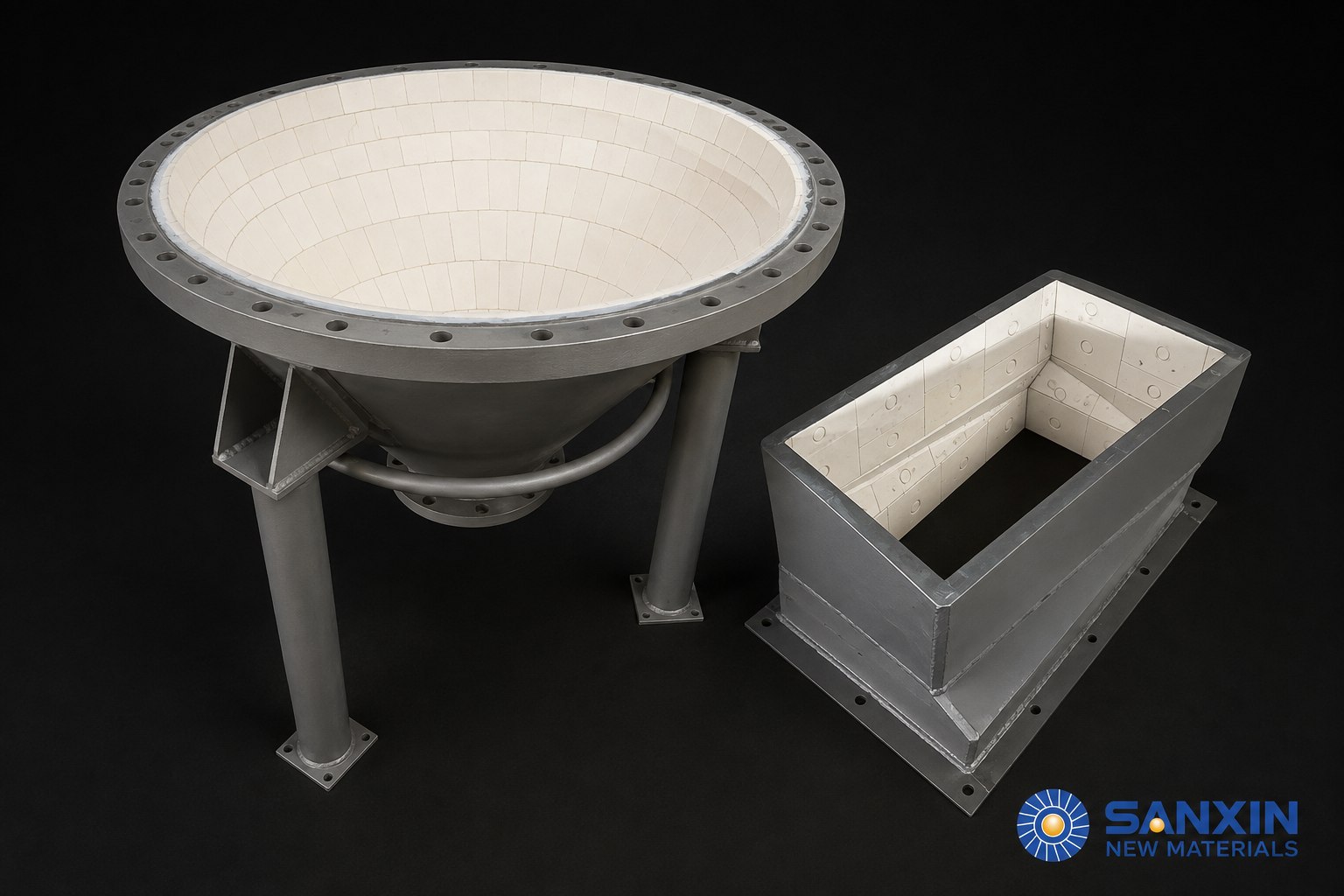
The word liner covers several different jobs. A stationary hopper wall and a rotating mill shell should never share a specification merely because both handle abrasive material. Identify the equipment type, the exact protected surface and whether the proposed lining performs a process function as well as a protective one.
For grinding mills, the equipment manufacturer's approved liner design is the starting boundary. Metso explains that shell liner profile and spacing influence charge movement, and that mill size, speed and impact conditions enter the design. This is a reason to involve the mill OEM before changing the arrangement, not evidence that any particular alumina product is suitable for every mill. See Metso's mill lining overview.
In the project scope, distinguish a ceramic-lined mill from its feed chute, discharge chute and storage hopper. These are separate review zones even when they belong to one production line. Specify which components may be replaced directly and which require an engineering change review. If the equipment model or original lining drawing is missing, resolve that information gap before ordering a substitute system.
Prepare a one-page operating envelope for each asset. Separate normal operation from credible upset conditions, and identify the records behind each entry. A nominal throughput alone says little about short bursts, large lumps, extended storage or unusual startup events.
For a hopper, record the handled material, particle-size range, largest expected pieces, moisture variation, feed location, drop arrangement, discharge method and periods of standing material. For a mill, add the approved speed range, media specification, charge information, wet or dry duty, product-quality requirements and cleaning procedure. These are enquiry inputs, not instructions to change operating settings.
Include normal and exceptional temperatures, relevant process chemistry, shutdown washing conditions and any previous lining failures. Ask who will confirm the suitability of the ceramic, attachment system, backing material and steel interface against those conditions.
Use three information labels: measured, estimated and unknown. An estimate should name its owner and basis. An unknown should remain visible until resolved. This prevents an attractive quotation from quietly turning missing operating data into an assumed design limit.
A useful wear map is a drawing that links location, observed condition and operating history. It is not simply a photograph of the worst damaged area. Give each face or sector a stable identifier, then use that identifier in photographs, measurements, quotations and future inspection reports.
For a hopper, start with the receiving area, sloping faces, corners, outlet transition and any gate or feeder interface. For a mill, follow the OEM's component naming and drawing references. Do not impose a generic sector pattern on equipment whose liner arrangement has a specific process purpose.
Record whether the observation is gradual surface loss, an isolated fracture, an open joint, a missing element, loose attachment or damaged backing. Those descriptions do not prove a root cause; they define what the investigation must explain. Note nearby repairs and changes in the incoming material path.
Where historical evidence is poor, commission a baseline survey rather than inventing an average wear rate. Preserve original photographs and measurement locations. The strongest future comparison is the same location, measured by a consistent method, with enough operating context to explain changes.
Zoning is a procurement method for discussing different demands within one asset. It does not prescribe a material grade. The proposed zones below should be checked against the actual wear map and material path.
Mark where incoming material first meets a surface, including changes caused by different feed conditions. Ask the supplier to explain the proposed impact assessment and the limits of the selected assembly. A hardness value alone should not close this review. Saint-Gobain's lining portfolio distinguishes sliding abrasion, erosion and impact performance across different ceramic systems; those categories are useful, but its product ratings are not Sanxin specifications. See its chute, bin and hopper lining overview.
Identify the surfaces along which material travels and the corners where the layout changes direction. Review the shape of transition pieces, the position of exposed edges and the access needed for future replacement. Require the drawing to distinguish designed joints from incidental gaps created during fitting.
Treat the outlet, gate, feeder and inspection openings as separate interfaces. Check that the proposed lining thickness, supports and fasteners do not occupy required clearances. Ask for explicit acceptance of the finished opening dimensions. Replacing a lining should not silently redefine the downstream equipment connection.
A wear-resistant surface is not proof of reliable bulk-solids flow. The proposal should state whether it addresses lining durability only or also includes a flow assessment. That distinction matters when a plant is simultaneously trying to reduce wear and eliminate plugging.
Jenike & Johanson identifies material behavior, including cohesion and wall friction, as part of the diagnosis of unreliable flow. Its guidance also emphasizes the relationship between hopper and feeder design. Therefore, if the retrofit changes the wall surface or outlet geometry, ask a qualified bulk-solids specialist whether relevant material testing is required. See Jenike & Johanson's flow reliability guidance.
For the enquiry, list any existing bridging, inconsistent discharge or buildup problems separately from wear. Record when each occurs and whether the operating team changes moisture, feed conditions or storage duration. Do not accept a universal wall angle or an unsupported promise that ceramic will prevent every blockage.
Define the project's flow acceptance evidence before installation. For example, the plant may choose to compare discharge consistency under agreed conditions. The test method, permitted operating range and responsible reviewer should be written into the project plan.
A controlled layout should let the buyer identify every replaceable component without reverse-engineering a photograph. Request an assembly drawing with revision, equipment orientation, zone identifiers, component schedule and the boundaries of supplied work.
For alumina ceramic liner systems, the review package should identify which items are standard pieces and which are shaped for the particular assembly. Ask for the agreed finished dimensions and the inspection method for critical interfaces. Do not infer an available custom size from a catalogue image.
Discuss the replacement sequence while reviewing the drawing. Can an individual section be accessed without disturbing adjacent sound sections? Are closures and corner pieces separately identified? Are lifting and handling provisions part of the supply, the installation contractor's work or the plant's responsibility?
Mark owner-supplied dimensions clearly. If the proposal relies on an existing steel shell being within an agreed condition, make that a hold point after removal of the old lining. A controlled drawing is useful only when the installed structure matches the assumptions recorded on it.
Retention means how the lining stays in its intended position throughout the agreed duty. Discuss it together with the ceramic geometry, supporting surface, backing arrangement and maintenance access. Do not treat attachment selection as a purchasing shortcut after the tile order is complete.
For a proposed bonded system, request the identified adhesive or bedding product, its application instructions and its stated service limitations. The installation plan should name the acceptance checks for surface preparation, application conditions and release to operation. Generic descriptions such as industrial adhesive are not enough to define an installation process.
For a proposed mechanical system, ask for an approved drawing showing the complete retention detail, accessible inspection points and replacement procedure. Fastener selection, tightening requirements and any welding work belong to the responsible engineering and installation specialists. This guide deliberately provides no generic bolt torque or welding prescription.
Where a rubber-backed or steel-backed arrangement is proposed, review the complete assembly and its interfaces rather than assessing only the ceramic face. Sanxin's public range includes several liner constructions, but their availability does not establish suitability for an unreviewed duty. Compare the proposed wear-resistant liner configurations against the operating envelope, not against an assumed hierarchy in which one construction is always best.
Ask the designer to show where joints are intended, how transitions are formed and how the first and last pieces are retained. A drawing should distinguish a designed clearance from an uncontrolled installation gap. There is no single joint dimension that this guide can responsibly assign to every ceramic lining.
During the review, mark the interfaces between flat faces and corners, between different lining constructions, and between the lining and an unlined opening. Ask how those interfaces will be inspected before they become difficult to reach. Record which parts must be fitted before adjoining sections are closed.
For a mill, preserve the approved relationship between components and do not introduce an unreviewed step, obstruction or local profile change. For a hopper, compare the finished transition with the intended material path and equipment clearances. These are design-review questions, not instructions to alter an existing machine.
Include repair boundaries in the drawing package. A future contractor should be able to distinguish an acceptable local replacement from a modification that requires a revised layout and renewed approval.
Hold points are planned opportunities to inspect work before the next activity hides it. They are particularly useful when fabrication, lining supply and installation involve different organizations. The following sequence is a proposed project framework, to be adapted by the responsible engineer.
Confirm asset identity, drawing revision and the isolation arrangements before work begins.
Inspect the exposed supporting structure after the old lining is removed, and resolve departures from the agreed condition.
Verify the dry-fit arrangement or other approved dimensional check before permanent attachment proceeds.
Record the specified preparation and attachment checks while the work remains accessible.
Confirm completion of the required curing, assembly and release checks before return to operation.
Allocate an owner to each sign-off. If a hold point fails, document the discrepancy and agreed correction rather than accepting a verbal instruction that cannot be traced later.
This list is not a safe-work method. Entry into mills, bins and hoppers, isolation of stored energy, falling-material hazards and hot work require the plant's approved procedures and appropriately qualified personnel. No inspection should be performed merely to obtain a photograph for the procurement file.
A useful acceptance plan states what will be checked, how it will be checked and who can accept a deviation. Separate incoming goods inspection from installed-system acceptance. A package can contain the right number of pieces and still require an installation correction.
At receipt, compare the component labels and quantities with the approved schedule. Record transport damage, unclear identification and drawing discrepancies. Keep questioned parts segregated through the plant's normal quality process until their disposition is agreed. Do not substitute visually similar pieces without approval.
For the completed lining, create a record of critical dimensions, zone photographs, specified attachment checks and any agreed exceptions. Keep the final drawing revision with this record. If the proposed verification method cannot see or measure an important feature after assembly, schedule that check earlier.
State the limits of the acceptance record. Passing an installation inspection confirms the documented checks; it does not prove a future service-life multiplier. Operating performance still needs follow-up under recorded conditions. Treat acceptance and performance validation as connected but distinct stages.
Create the baseline immediately after the completed installation has passed the agreed checks and before operational wear makes the starting condition ambiguous. Use consistent zone identifiers and photograph orientations. Where measurements are specified, record the method, instrument identification and location reference so another inspector can repeat the work.
For mill applications, inspection planning should follow the OEM and plant requirements. Metso describes using visual checks together with wear measurements and operating history to understand liner condition. Its recommendations concern its own mill expertise; they do not supply universal intervals for every ceramic-lined asset. See Metso's mill liner inspection guidance.
A practical record can contain the zone, observed condition, measured change where available, supporting photograph, operating exposure and follow-up action. Assign each concern a responsible reviewer. If a measurement is inaccessible or unreliable, report that limitation instead of filling the cell with an estimate presented as fact.
Agree on review timing and escalation criteria before startup. The appropriate interval depends on the application and its approved maintenance plan, not on a generic calendar copied from another plant.
Inspection terminology should guide the next investigation. Gradual loss of ceramic material, a fresh fracture and a displaced lining element are different observations. Combining them under the label worn out can hide important questions about the assembly and operating history.
For each finding, record what is directly visible before discussing a cause. Capture the location, extent, surrounding condition and any recent change in operation. Ask the responsible specialist whether nearby components or the supporting structure also need inspection. A photograph alone may not reveal the condition behind the ceramic face.
Use a disposition process with clear categories: acceptable within the approved criteria, monitor at an agreed interval, investigate before continued service, or repair under an approved scope. The plant and responsible engineer must set those criteria; this article supplies no universal crack size or minimum remaining thickness.
Retain removed parts when they are needed for an agreed investigation, label their original locations and preserve the associated operating record. Replacing a failed item restores the assembly only if the replacement and underlying condition meet the approved requirements.
A spare-parts plan should follow the actual layout and lead-time risk. Buying a random percentage of extra tiles can leave a plant with ample straight pieces but no correct corner or closure component. Start with the approved part schedule and identify items that cannot be substituted safely.
Ask for the storage and identification requirements of each supplied component, including adhesives or backing assemblies where applicable. Verify shelf-life information from the actual product documentation rather than applying one generic storage rule to the whole shipment.
For each critical zone, define the minimum repair package: identified lining components, required attachment consumables, current drawings and the approved work instructions. Check which special tools or access arrangements must be available during a shutdown.
Keep the spare schedule synchronized with drawing revisions. After a trial modification, superseded parts should not remain indistinguishable from current stock. Record whether they are still approved for another location, require review, or must be handled through the plant's normal disposition process.
An extended service-life claim is meaningful only when its basis is stated. Compare like-for-like operating exposure, the same replacement criteria and an identifiable baseline. Do not transfer another supplier's case study or another plant's result to a Sanxin proposal.
A buyer can build an internal comparison using recorded material throughput, operating hours, replacement scope, maintenance labor, consumables and verified production interruptions. Keep actual expenses separate from forecasts. If a cost or exposure figure is unavailable, mark it unknown and show how it limits the comparison.
For a first installation, agree on a trial review rather than announcing a guaranteed outcome. Decide which locations will be measured, what constitutes an acceptable operating record and when both parties will review the findings. A successful small trial can support a larger discussion, but it does not automatically validate every zone or a different material duty.
The objective is a defensible maintenance decision: what worked, under which conditions, at what verified cost, and with which remaining uncertainties. That is more useful than an unsupported claim that every ceramic lining lasts a fixed number of times longer.
Send Sanxin New Materials the asset identification, approved equipment drawings, operating envelope, wear map and the boundaries of the proposed retrofit. Include photographs with location labels, required shutdown timing and the responsibilities already assigned to the OEM, plant and installation contractor.
Request a proposal that separates confirmed scope from options and unresolved assumptions. Ask for the proposed component schedule, retention concept, inspection deliverables and the information still needed before manufacturing approval. Confirm product availability, documentation, commercial terms and delivery arrangements directly; this guide makes no stock, certification or lead-time claims.
Review the ceramic wear-resistant parts selection as a starting catalogue, then compare the response with your actual requirements. The final decision should connect a clearly defined duty to a controlled layout, an approved retention method and a repeatable inspection plan. That connection is what turns a collection of ceramic components into a maintainable lining system.

Подайте ваш запрос,
Мы свяжемся с вами как можно скорее.

Sanxin New Materials Co., Ltd. специализируется на производстве и продаже керамических бусин и деталей, таких как шлифовальные средства, струйные бусины, подшипник, часть конструкции, керамические износостойкие вкладыши, наночастицы нанопорошка


 Английский язык
 Английский язык
 Русский язык
 Французский язык
 На испанском языке
 На португальском языке
 Арабский язык